
- X
Els orgues
Minor Organ
Positive Organ
The Former Great Organ
History of the Organs
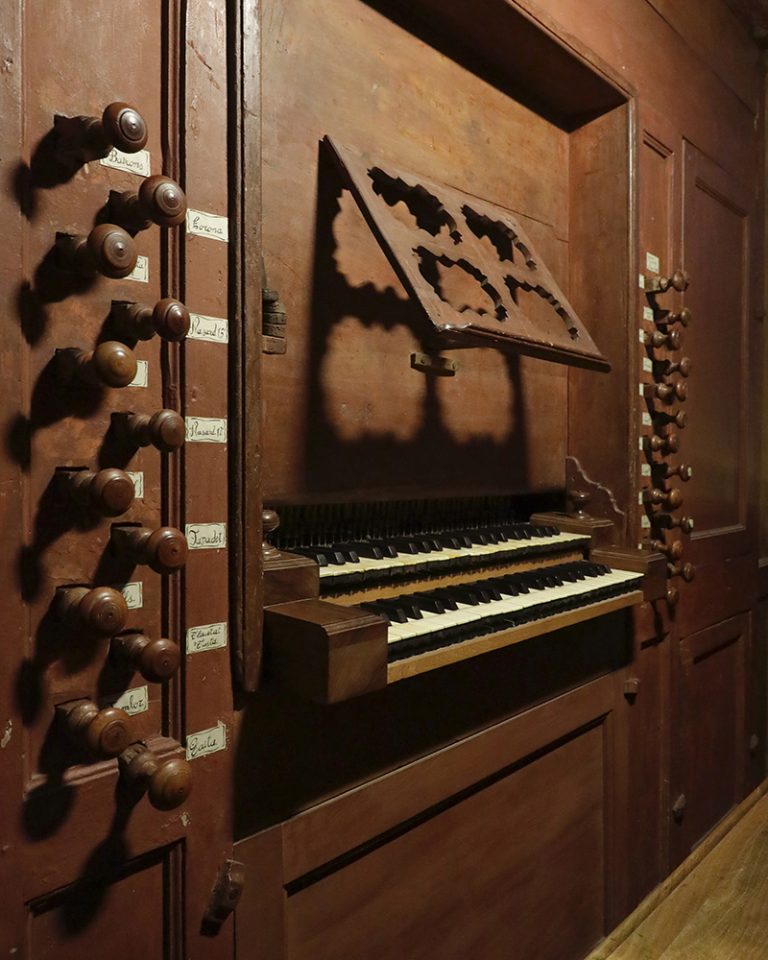
Minor Organ. Unknown builder, c. 1740, Catalan school, 18th century. 22 stops, II/C. Restoration: Gerhard Grenzing, 1997–2005. © Martin Doering.
Minor Organ
The instrument currently heard at Santa Maria was originally built for the Convent of the Trinitarians in Vic. The style of the case and its decorative ornamentation correspond to the second half of the eighteenth century. However, to date, no documentation—either on the instrument itself or in archival records—has been found to confirm the exact date of its construction or the identity of its builder. Nevertheless, it is one of the most significant historic organs in the metropolitan area of Barcelona.
Around 1983, certain elements of the instrument were discovered in the storeroom of an antique dealer, dismantled by non-professional hands. Other components, such as the manual and the bellows, were found in a farmhouse near Vic. Altogether, the instrument appeared as little more than a heap of scrap metal, difficult to identify.
In addition to restoring the case, it was necessary to undertake a full reconstruction, replace missing parts, and design and build a new gallery in keeping with the style of the case. Of the pipework, only approximately 80 wooden pipes—about 6% of the total—had survived.
To reconstruct the missing 94%, it was necessary to trace the evidence remaining on the façade pipe supports, the rollerboards, and the windchests. Based on this information, a probable stoplist was devised, including the corresponding pipe measurements and diameters. Notable features of this instrument include the division of the manual between B–C¹ (in contrast to the Spanish organ tradition, which divides between C¹–C♯¹) and the presence of a wooden flue stop.
The remaining mechanical, structural, and decorative elements were restored using period techniques. In the case of the bellows, it was necessary to reconstruct the tables, as the originals were beyond repair; however, the original folds have been preserved as documentation. These are among the few surviving wedge bellows in Catalonia, together with those of the Sanctuary of El Miracle in Solsona, La Pobla de Cérvoles, and Ulldemolins.
The organ was installed in the space formerly occupied by the now-vanished Royal Gallery, which itself had been built on the site of the previous minor organ of Santa Maria del Mar.
Stop disposition:
|
Cadireta I 45 notes: C,D,E,F,G,A-c’’’ |
Orgue Major II 45 notes: C,D,E,F,G,A-c’’’ |
||
|---|---|---|---|
| Bordó | 8' | Cara | 8' |
| Cara | 4’ | Flautat de fusta | 8' |
| Flauta xemeneia | 4’ | Octava | 4’ |
| Quinzena II | 2’ + 1 ⅓’ | Tapadet | 4’ |
| Nasard 19a | 1 ⅓’ | Nasard 12a (h/c’) | 2 ⅔’ |
| Cimbalet III | 1’ | Quinzena II | 2’ + 1’ |
| Regalia | 8’ | Nasard 15a (h/c’) | 2’ |
| Nasard 17a (d’-c’’’) | 1 ⅗’ | ||
| Corona IV (h/c’) | 1 ⅓’ | ||
| Ple III | 1’ | ||
| Cimbalet III | ⅔’ | ||
| Corneta VII (c’-c’’’) | 8’ | ||
| Trompeta real (h/c’) | 8’ | ||
| Baixons - Clarins (h/c’) | 4’ - 8’ | ||
|
Pedal 8 notes: C,D,E,F,G,A,B,H |
Miscel·lània i acoblaments |
||
| Vent al pedal (Contres II) | 8’ | Trèmol | (II) |
| Ocells | |||
| Tambor en mi | |||
| Gaita (IV) en mi | |||
|
Diapasó: a' 412.0 Hz a 20 °C Temprament: mesotònic 1/5’ modificat |
Cadireta al Major | ||
| Major al Pedal (permanent) | |||
| Total tubs: 1575 | |||
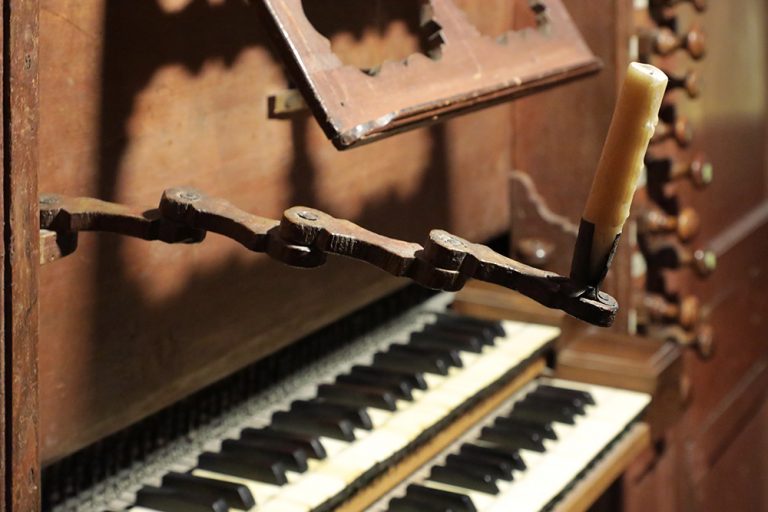
Minor Organ. Unknown builder, c. 1740, Catalan school, 18th century. 22 stops, II/C. Restoration: Gerhard Grenzing, 1997–2005. © Martin Doering.
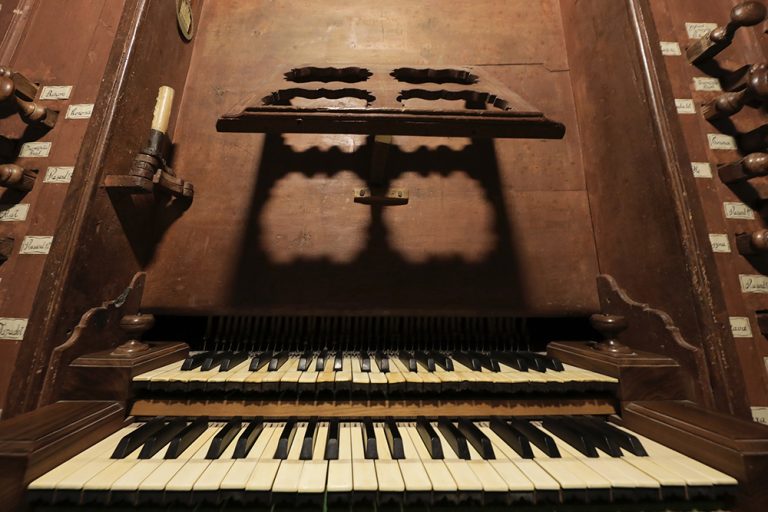
Minor Organ. Unknown builder, c. 1740, Catalan school, 18th century. 22 stops, II/C. Restoration: Gerhard Grenzing, 1997–2005. © Martin Doering.
Positive Organ
This small, portable organ is particularly well suited to chamber music with singers or instrumentalists, where close proximity between performers is essential for a refined interpretation. It was acquired at a time when the Basilica had long been in need of an organ, prior to the installation of the present Minor Organ and during the flourishing period of the Music Chapel of Santa Maria del Mar.

| 54 notes: C-f’’’ | |
|---|---|
| Bordó (c’/cis’) | 8' |
| Tapadet (c’/cis’) | 4’ |
| Quinzena (c’/cis’) | 4’ |
| Dinovena (c’/cis’) | 1 ⅓’ |
| Dissetena (cis’-f’’’) | 1 ⅗’ |
| Regalia (c’/cis’) | 8 |
| Transpositor: a’ ≈ 415, 440 Hz a 20ºC Temprament igual | |
| Total tubs: 304 | |
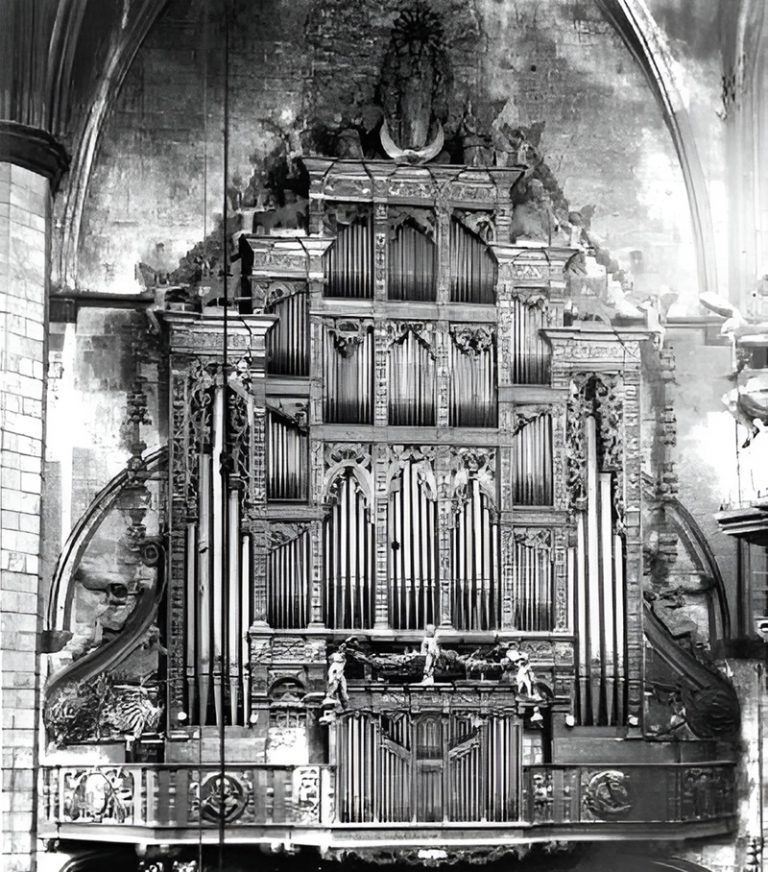
Jean-Pierre and Dominique Cavaillé, 1797. 46?, III/C. Reconditioning: Joan Puig (1854).
The Former Great Organ
Although today only its silhouette can be discerned, this organ occupied, from 1797 until 1936, the space opposite the present Minor Organ. It was undoubtedly one of the most significant instruments in Catalonia and, although reliable data concerning its stop disposition are scarce, numerous sources praise its excellence.
It was a monumental organ in which the pleno stops, reeds, and cornets played a particularly prominent role.
The instrument was completely destroyed during the fire that devastated the Basilica on the night of 19–20 July 1936, at the outbreak of the Spanish Civil War.
In recent years, thanks to various sources referring to the number and names of the console stops, descriptions by the last organist who played it, inventories, photographs, and accounts of similar instruments—such as the former organ of Vic Cathedral and the present organ of Castelló d’Empúries—it has been possible to reconstruct a plausible technical profile of this organ.
Hypothetical stop disposition:
|
Orgue Major (II) 50 notes: C,D-d’’’ |
Cadireta (I) 50 notes: C,D-d’’’ |
||
|---|---|---|---|
| Flautat | 28 pams | Cara | 14 pams |
| Bordó | 28 pams | Flauta | 14 pams |
| Flauta(t) | 14 pams | Octava | 7 pams |
| Cara | 14 pams | Flauta | 7 pams |
| Flauta | 7 pams | Nasard 12a | 2 ⅔’ |
| Octava 1 | 4’ | Nasard 17a | 1 ⅗’ |
| Octava 2 | 4’ | Ple 15a (II?) | 2’ + 1 ⅓’? |
| Ple 12a (III?) | 2 ⅔’ + 2’? | Ple 1 (III?) | 1 ⅓’ (?) |
| Ple 1 (III?) | 2’(?) | Ple 2 (III?) | 1’ (?) |
| Ple 2 (III?) | 1 ⅓’ (?) | Trompa real | 8’ |
| Ple 3 (III?) | 1’ (?) | Cromorns | 8’ |
| Ple 4 (IV?) | 1 ⅓’ (?) | Clarins | 4’ |
| Nasard 12a (c’/cis’?) | 2 ⅔’ | Eco (III) 27 o 50 notes: C,D-d’’’ o c’-d’’’ | |
| Nasard 15a (c’/cis’?) | 2’ | ||
| Nasard 17a (c’/cis’?) | 1 ⅗’ | Bordó | 8’ |
| Corneta V? (c’-d’’’) | Flauta(t) | 4’(?) | |
| Corneta VII? (c’-d’’’) | Octava | 4’ | |
| Fagot / Oboè (c’/cis’?) | 8’ | Violins (c’-d’’’) | 8’ |
| Clarinet (c’/cis’?) | 8’ | Veu humana (c’-d’’’) | 8’ |
| Bombarda (c’/cis’?) | 16’ (1a octava 8’) | Cornetilla (III?) (c’-d’’’) | |
| Trompeta real (c’/cis’?) | 8’ |
Pedal 8 o 12 notes? (C-H) |
|
| Clarí (c’/cis’?) | 4’ | ||
| Trompeta de batalla (c’/cis’?) | 8’ | Contras | 16’? |
| Clarins (c’/cis’?) | 4’ | Contras | 8’? |
| Baixons (c’/cis’?) | 4’ / 8’ | Bombarda? | 16’? |
| Clarins 15a (C,D-c’?) | 2’ | ||
| Miscel·lània i acoblaments | |||
| Carassa | Aucells | Tambor? | Trèmol? |
| Cadireta a Major? | Major a Contres? | ||
|
Temprament i diapasó desconeguts Aproximació total tubs: 3152 |
|||
History of the Organs
A historical overview of the organs of Santa Maria del Mar
After Francesc Baldelló published a short monograph in 1962 on music at the parish of Santa Maria del Mar—based, of course, on information previously published by other scholars and on his own research, which we may assume was largely carried out before the destruction of the parish archive in July 1936—very little unpublished information can be added concerning the history of the organs of the Barcelona basilica. This is not so much because the aforementioned study was entirely exhaustive—indeed, we wish to acknowledge the great scholarly work of Mossèn Baldelló—but rather because the most significant body of documentary evidence, which might still have yielded new findings, has disappeared forever. Naturally, other documentary sources do exist—especially the Historical Archive of Protocols of Barcelona—which can hardly be considered fully explored, and from which further unknown information may one day emerge.
[…]
The earliest documented reference dates from 1393—less than ten years after the first Mass celebrated in the Gothic church—when Bernat Pons, or Ponç, was commissioned to build an instrument whose characteristics remain unknown. It appears, moreover, that this Bernat Pons may be identified with the chanter of the same name who served Kings John I and Martin the Humane.
No further information is known until 1464. At that time, the Board of Works requested the services of a German friar and organ builder, Frater Leonardus, to undertake some form of repair. By 1484, the organ had become unusable, and the construction of a new instrument was agreed upon. From the outset, the intention of the churchwardens was to provide themselves with an organ befitting the grandeur and prestige of the church. Thus, the organ builders known as “the Marturians”—the brothers Antoni, a monk of Poblet, and Marturià, who had belonged to the royal chapel and alternated the craft of organ building with that of singer-composer—competed with Johann Spin von Noyern. After much deliberation, the German’s project—representing a more innovative option—was chosen, and he completed the instrument in 1486. The examiners’ words express their approval and admiration: “…declaring that, having seen, touched and heard the said organ, the said organ was good, good and good.” It appears that at the same time the same builder constructed a smaller organ as well.
It is recorded that in 1514 the “Marturians” built new fixed organs. These were likely minor organs; it seems improbable that the great organ would have been replaced after so few years. Following this date, a series of minor interventions are documented, culminating in the works carried out in 1547 by Pere Bordons and, between 1560 and 1576, by Pere Rabassa, Josep Bordons and Salvador Estada. Unfortunately, reliable information does not reappear until 1677. We know that the prestigious Aragonese organ builder José de Sesma carried out important work, although the details remain unknown.
At the close of the seventeenth century, when a complete reform of the organ became necessary, the churchwardens of Santa Maria del Mar once again turned to a northern builder. This time it was the Flemish Andreu Bargere who, in 1691, was entrusted with rebuilding the organ from top to bottom. The surviving documentation, however, does not allow us to determine the full extent of this reform. A few years later, in 1719, the Majorcan Josep Bosch also carried out certain repairs. It was in 1741, however, that Antoni Boscà—who had been responsible for maintaining the organs of Santa Maria since 1734—constructed an almost entirely new instrument. His work represents one of the great achievements of the Boscà lineage and a magnificent synthesis of the Catalan and Castilian organ traditions. Broadly speaking, this involved maintaining the three sound bodies, incorporating divided stops and horizontal trumpet pipes, and abandoning the short octave in the great organ.
Around 1790, this organ appears to have suffered from serious deterioration. Consequently, in 1794 Jean-Pierre and Dominique Cavaillé—father and son—began work on a new organ, which was inaugurated on Christmas Day 1797. After restoration by Joan Puig in 1854, this was the instrument that remained in use until 1936. In the words of Mossèn Frederic Muset, titular organist from 1925 until the early 1970s, it was described as follows: “…I counted up to 31 stops. The pleno stops formed one of its most characteristic features, some comprising up to 17 ranks. They possessed a sublime sonority. The trumpets and cornets had a brilliant richness…” Nothing remained of this magnificent organ after the fire of 20 July 1936.
In 1943, following the demolition of the Palau de Belles Arts in Barcelona, it was decided to transfer its organ—built by Aquilino Amézua—to Santa Maria del Mar. Although the transfer, entrusted to the organ builder Antonio Alberdi, appears to have been carried out, the installation was never completed, and the last remaining parts disappeared with the demolition of the bridge over the Fossar de les Moreres.
Bernat Cabré
Bibliography
– BALDELLÓ, F. “Órganos y organeros en Barcelona”, Anuario Musical, I, 1946.
“La Música en la basílica de Santa Maria del Mar” Anuario Musical, XVII 1962.
– BASSEGODA I AMIGÓ, B. Santa Maria de la Mar. Monografia històrico-artística del temple. Barcelona, 1925.
– CABRÉ, B. “Un orgue d’Antoni Boscà per a Santa Maria del Mar (1741)”, Anuari de l’orgue, I, 2002.
– MADURELL, J.M. “Documentos para la historia de maestros de capilla, organistas, órganos, organeros, músicos e instrumentos”, Anuario Musical, IV, 1949.
– SOLER I PALET, J. “La música a Catalunya, aplega de materials per a contribuir a sa història. A Santa Maria del Mar”, Revista Musical Catalana, XV, 1918 / XVI 1919. / XVIII 1921.